Topics in this domain
- ISACA Code of Professional Ethics
- ITAF: The Standards Framework
- Standards vs. Guidelines vs. Tools
- Auditor Independence and Objectivity
- Audit Charter: Purpose and Contents
- Audit Testing: Compliance vs. Substantive
- Financial vs. Operational vs. Integrated Audits
- Forensic and Specialized Audits
- Risk-Based Audit Approach
- Inherent, Control, Detection, and Audit Risk
- Audit Universe and Annual Audit Plan
- Audit Objectives, Scope, and the Audit Program
- Types and Reliability of Audit Evidence
- Sampling: Statistical vs. Non-Statistical
- Sampling Terms: Confidence Level, Tolerable Error and Friends
- Interviews, Observation, and Walkthroughs
- CAATs and Data Analytics
- Continuous Auditing and Monitoring
- Preventive, Detective, Corrective Controls
- General vs. Application Controls
- Compensating Controls and Segregation of Duties
- Materiality and Evaluating Findings
- Audit Report Structure and Communication
- Follow-Up and Management Action Plans
- Control Self-Assessment (CSA)
- Audit Quality and Using Other Experts' Work
Auditor Independence and Objectivity
Why it matters
An audit opinion is only valuable if the auditor was free to say what they found. If the auditor works for the person they’re auditing, or is checking their own work, nobody can be sure the opinion is honest, even if it actually is.
Think of a football referee. Imagine one team’s coach refereeing the match. They might be perfectly fair. But nobody watching would believe it, and the result would be worthless. Auditors need to be fair and obviously fair.
That’s why ITAF has two separate standards: one about the independence of the audit function, and one about the objectivity of each auditor.
Two related ideas
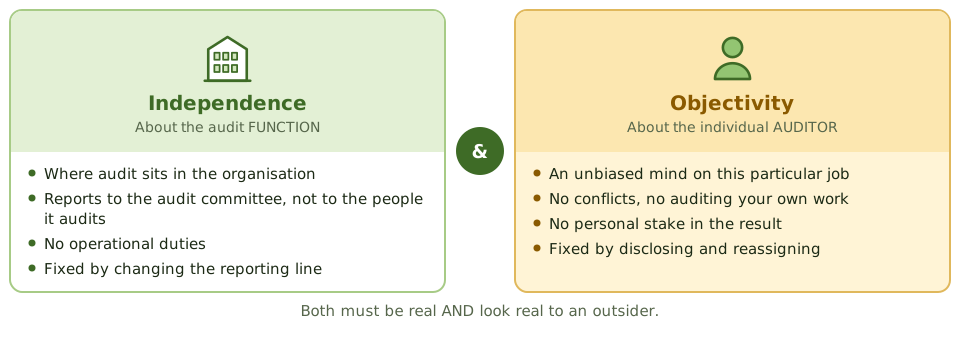
| Independence | Objectivity | |
|---|---|---|
| Applies to | The audit function | The individual auditor |
| About | Where audit sits, and who can influence it | An unbiased mind on a specific job |
| Threatened by | Bad reporting lines, operational duties, scope or budget controlled by auditees | Conflicts of interest, auditing your own work, personal relationships |
| Typical fix | Change the reporting line; remove operational duties | Disclose; reassign the work |
Both must exist in fact (they’re really unbiased) and in appearance (an outsider would agree). An exam answer that says “the auditor is confident they can remain objective” doesn’t fix a problem that’s visible to others.
Who audit reports to
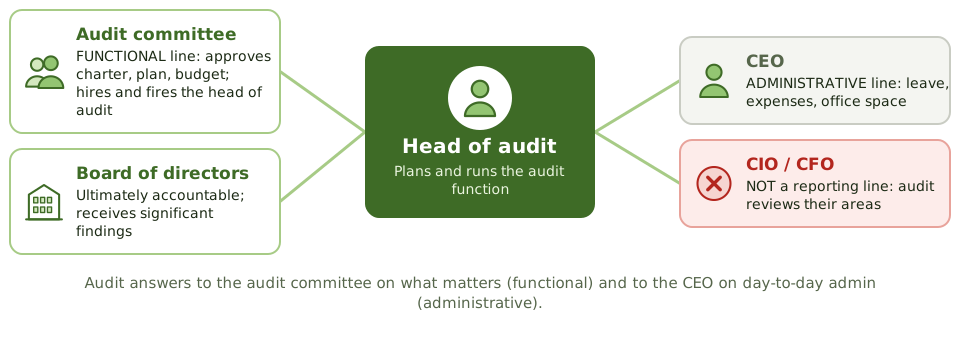
The standard arrangement has two reporting lines:
- Functional reporting to the audit committee (or board). This covers everything that affects audit’s freedom: approving the charter, the audit plan and the budget, and appointing or removing the head of audit.
- Administrative reporting to senior management, usually the CEO. This covers day-to-day matters such as leave, expenses and office space.
Independence is impaired when audit:
- reports to someone whose area it audits, such as the CIO or CFO
- has operational jobs, such as running security administration or approving changes
- has its scope, budget or reports controlled by the people it audits
Example. The IS audit team reports to the CIO, who also sets its budget. Next year’s plan quietly leaves out the CIO’s big ERP project. The fix isn’t “be braver”. It’s changing the reporting line so the audit committee approves the plan.
Threats to an individual auditor’s objectivity
| Threat | Everyday example | What to do |
|---|---|---|
| Self-review | Auditing a system you designed, or a team you recently worked in | Someone else audits it; allow a cooling-off period, often a year |
| Self-interest | Owning shares in a vendor you’re reviewing | Disclose; step off the audit |
| Familiarity | Auditing your best friend’s department, or the same area for many years | Rotate assignments |
| Intimidation | A manager hinting your career will suffer if a finding stays in | Escalate to audit management or the audit committee |
| Management participation | Approving transactions or making decisions for the auditee | Stop: audit doesn’t do management’s job |
Auditors on projects
Auditors are encouraged to get involved early in system projects, because fixing a missing control at the design stage is far cheaper than finding it after go-live. The line is between advising and doing:
- Fine: reviewing designs, recommending controls, commenting on test plans, attending steering meetings as an observer.
- Not fine: designing or building controls, approving the system for go-live, performing user acceptance testing, having a vote on project decisions.
If an auditor did cross that line, they shouldn’t later audit the system, or the conflict must be disclosed and the work reviewed by someone else.
Non-audit work
Audit sometimes helps with consulting work, such as running a control self-assessment workshop. That’s acceptable when management keeps ownership of the decisions and audit only facilitates and advises.
When objectivity is at risk
- Spot it, ideally before the audit starts.
- Disclose it to audit management, and to the audit committee if needed.
- Resolve it: reassign the work, use another team, or decline.
- Report it: if it couldn’t be avoided and affected the work, say so in the report.
How the exam asks about it
| If the question asks… | The answer is usually… |
|---|---|
| Best way to ensure the audit function’s independence | Functional reporting to the audit committee |
| The auditor previously designed the system being audited | Disclose; another auditor should do the review |
| An auditor joins a development project | Fine as an adviser; not in design, implementation or approval |
| Greatest threat to independence | Audit reporting to, or being controlled by, the area it audits |
| The auditee offers gifts or hospitality | Decline or disclose: it threatens objectivity in appearance |
In short
- Independence is about the audit FUNCTION: where it sits and who controls it. Objectivity is about the individual AUDITOR's state of mind on a job.
- Both must exist in fact and in appearance. If an outsider would doubt it, there's a problem.
- Audit reports functionally to the audit committee (charter, plan, budget, hiring) and administratively to senior management (day-to-day admin).
- An auditor must not audit work they designed, built or ran, or an area they recently worked in.
- Advising a project on controls is fine. Designing, approving or running the controls is not.
- When objectivity or independence is at risk: disclose it, and normally reassign the work.
Exam traps
- 'I'm sure I can stay objective' doesn't solve anything if it doesn't LOOK objective.
- Audit reporting to the CIO or CFO is an independence problem when it audits their areas.
- Rotating auditors helps with familiarity. It doesn't fix a bad reporting line.
- The fix for an impaired auditor is disclosure and reassignment, not 'being extra careful'.
- An auditor on a project steering committee should be an adviser or observer, not a voting member.
Slides
Click the slide and use the arrow keys. F toggles full screen.
Two related ideas
Who audit reports to
The standard arrangement splits audit's reporting into two lines. The audit committee handles everything that affects audit's freedom; the CEO handles day-to-day administration.