Topics in this domain
- IT Governance vs. IT Management
- Board and Senior Management Roles
- IT Steering Committee
- IT Strategy and Business Alignment
- Balanced Scorecard
- COBIT
- ITIL
- ISO 27001/27002
- COSO: ERM and Internal Control
- Policies, Standards, Procedures, Guidelines
- IT Organizational Structure and Key Roles
- Segregation of Duties in IT
- Enterprise Architecture (Zachman, TOGAF)
- Risk Management Process
- Qualitative vs. Quantitative Risk Assessment
- Risk Responses: Mitigate, Transfer, Avoid, Accept
- Risk Appetite and Residual Risk
- Maturity Models (CMMI)
- KPIs and KGIs
- Outsourcing: Benefits and Risks
- Vendor Selection, Contracts, SLAs, Right to Audit
- Cloud and Offshore Governance
- Portfolio and Resource Management
- HR: Hiring, Training, Termination
- Legal and Regulatory Compliance
- Quality Management
Balanced Scorecard
Why money isn’t enough
Imagine judging a football team only by last season’s prize money. You’d miss that its best players are leaving, its training ground is falling apart, and the fans are unhappy. Next season could be a disaster, and the money figures wouldn’t warn you.
Budget figures are lagging indicators: they show what already happened. A balanced scorecard adds measures from other angles, including ones that predict future performance.
The four perspectives
The original business scorecard looks at financial, customer, internal process, and learning and growth. The IT balanced scorecard adapts these:
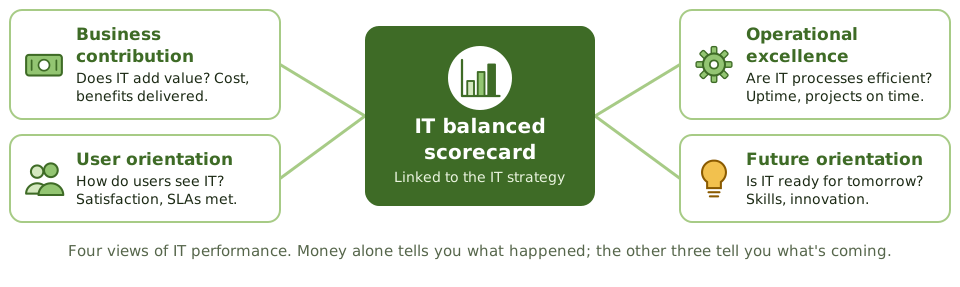
| IT perspective | Question | Example measures |
|---|---|---|
| Business contribution | Does IT add value to the business? | IT cost as a share of revenue; benefits delivered by projects |
| User orientation | How do users see IT? | User satisfaction; SLAs met; incident resolution time |
| Operational excellence | Are IT processes efficient and effective? | Availability; change success rate; projects on time and on budget |
| Future orientation | Is IT ready for what’s coming? | Training hours; skills coverage; innovation pipeline |
Its role in IT governance
The scorecard supports performance measurement, one of the focus areas of IT governance. It:
- turns IT strategy into measurable goals
- shows the board how IT contributes to business goals
- balances short-term results against long-term capability
- gives a basis for corrective decisions
A scorecard needs an agreed strategy with defined goals first. Without that, there’s nothing to measure against.
Example. A CIO reports only budget variance to the board. A balanced scorecard would add user satisfaction, availability of critical systems, the share of projects delivering their promised benefits, and progress on cloud skills, giving the board a far fuller picture.
How the exam asks about it
| If the question asks… | The answer is usually… |
|---|---|
| Purpose of an IT balanced scorecard | Measure IT performance and its contribution to business objectives |
| What’s needed before implementing a scorecard | A defined strategy and goals |
| Perspective covering skills and innovation | Future orientation (learning and growth) |
| Weakness of measuring IT only by budget | Lagging, one-dimensional view of performance |
In short
- A balanced scorecard measures performance from several perspectives, not just money.
- The IT balanced scorecard usually has four: business contribution, user orientation, operational excellence and future orientation.
- In IT governance, it's a tool for measuring and reporting how well IT is performing and contributing to business goals.
- Good scorecards mix lagging measures (results) with leading measures (what drives future results).
- You need an agreed strategy first; the scorecard measures progress against it.
Exam traps
- The scorecard is a performance measurement tool, not a risk assessment or project planning technique.
- A scorecard with only financial or only technical measures isn't balanced.
- Before building a scorecard, the strategy and goals it measures must be defined.
Slides
Click the slide and use the arrow keys. F toggles full screen.
Four views of IT performance