Topics in this domain
- IT Governance vs. IT Management
- Board and Senior Management Roles
- IT Steering Committee
- IT Strategy and Business Alignment
- Balanced Scorecard
- COBIT
- ITIL
- ISO 27001/27002
- COSO: ERM and Internal Control
- Policies, Standards, Procedures, Guidelines
- IT Organizational Structure and Key Roles
- Segregation of Duties in IT
- Enterprise Architecture (Zachman, TOGAF)
- Risk Management Process
- Qualitative vs. Quantitative Risk Assessment
- Risk Responses: Mitigate, Transfer, Avoid, Accept
- Risk Appetite and Residual Risk
- Maturity Models (CMMI)
- KPIs and KGIs
- Outsourcing: Benefits and Risks
- Vendor Selection, Contracts, SLAs, Right to Audit
- Cloud and Offshore Governance
- Portfolio and Resource Management
- HR: Hiring, Training, Termination
- Legal and Regulatory Compliance
- Quality Management
Enterprise Architecture (Zachman, TOGAF)
A map of the organisation
Imagine a city with no planning office. Everyone builds wherever they like: three hospitals on one street, no roads between neighbourhoods, water pipes that don’t connect. Enterprise architecture is IT’s planning office. It maps what exists, decides what the city should look like, and checks every new building fits the plan.
Enterprise architecture (EA) documents the organisation’s business processes, information, applications and technology, and how they relate to each other. Its purpose is to guide change: making sure IT investments fit together, support the strategy, and don’t add needless complexity or duplication.
Current state to target state
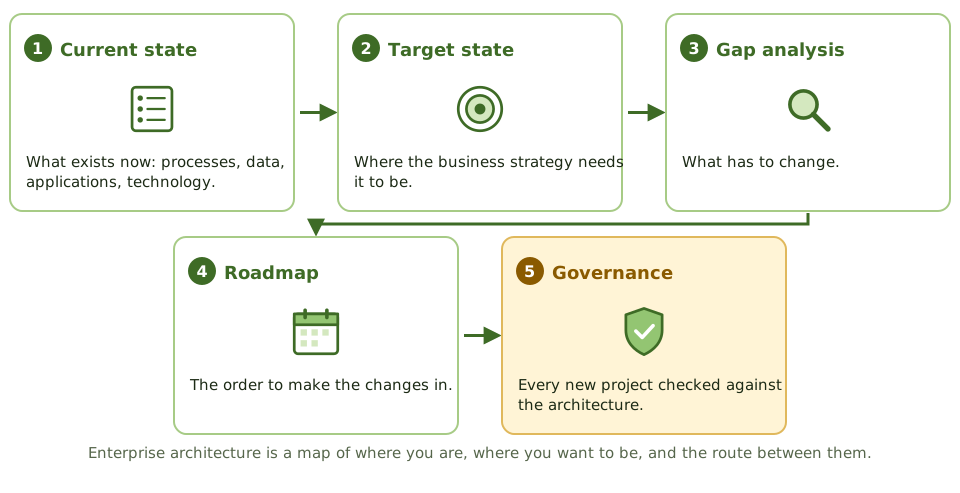
A typical EA effort describes:
- the current state (baseline): what exists today
- the target state: where the business strategy needs things to be
- the gaps between them
- a roadmap of projects to close the gaps
Zachman and TOGAF
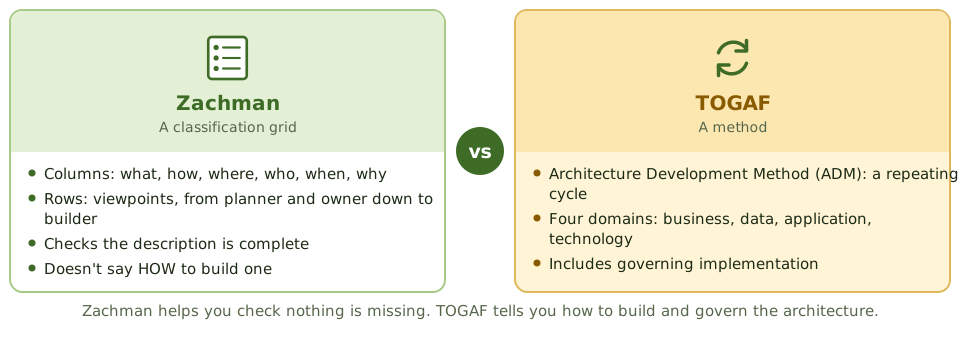
Zachman is a grid for organising architecture descriptions:
- Columns are questions: what (data), how (function), where (network), who (people), when (time), why (motivation).
- Rows are viewpoints, from the planner and the business owner down to the designer, builder and the working system.
It’s useful for checking the architecture is described completely. It doesn’t tell you how to build one.
TOGAF (The Open Group Architecture Framework) provides a method: the Architecture Development Method (ADM), a repeating cycle covering vision, business architecture, data and application architecture, technology architecture, solutions, migration planning, implementation governance and change management. TOGAF uses four architecture domains: business, data, application and technology.
Why it pays off
- IT investment lines up with business strategy
- less duplication and lower complexity
- a basis for judging proposed projects and purchases
- a clear picture of dependencies, which helps risk and continuity planning
Auditing EA
- Does an approved, maintained architecture exist?
- Is there an architecture function or board with real authority?
- Are new projects and purchases reviewed against the architecture?
- Are exceptions approved and tracked?
Example. Three departments each buy their own CRM tool without consulting IT. An architecture review process, checking new systems against the target architecture, would have flagged the duplication and the integration cost before anyone signed a contract.
How the exam asks about it
| If the question asks… | The answer is usually… |
|---|---|
| Main purpose of enterprise architecture | Align IT investment with strategy; understand and manage complexity |
| Framework that is a classification grid | Zachman |
| Framework with a development method (ADM) | TOGAF |
| Best evidence EA is effective | Projects are assessed against the architecture before approval |
In short
- Enterprise architecture (EA) documents how the organisation's processes, information, applications and technology fit together, to guide change.
- It describes the current state, the target state, the gaps, and a roadmap between them.
- Zachman is a grid for classifying architecture descriptions: questions (what, how, where, who, when, why) against viewpoints.
- TOGAF provides a method, the Architecture Development Method (ADM), for building and governing architecture.
- EA supports alignment, reduces duplication and complexity, and gives a basis for judging new investments.
- The auditor checks EA exists, is kept current, and that projects are actually checked against it.
Exam traps
- Zachman is a classification grid, not a process. TOGAF's ADM is the process.
- An EA nobody uses in investment decisions has little value.
- TOGAF's four domains are business, data, application and technology.
Slides
Click the slide and use the arrow keys. F toggles full screen.
Current state to target state
Zachman and TOGAF