Topics in this domain
- Project Roles and Governance
- PMBOK Phases
- Gantt, PERT, Critical Path
- Function Point Analysis
- Earned Value and Project Risk
- Business Case and Feasibility
- Benefits Realization
- SDLC Phases Overview
- Requirements Definition
- System Design
- Waterfall vs. Iterative vs. Prototyping
- Agile
- DevOps and DevSecOps
- RAD, CASE, Low-Code
- Build, Coding Standards, Code Review
- Testing Levels: Unit, Integration, System, UAT
- Regression, Sociability, Parallel, Pilot Testing
- Defect Management
- Data Migration and Conversion
- Change-Over: Parallel, Phased, Abrupt
- Go-Live Readiness and Acceptance
- Post-Implementation Review
- Input Controls
- Processing Controls
- Output Controls
- Data Integrity and ACID
- EDI and E-Commerce Controls
Gantt, PERT, Critical Path
Scheduling a project
Think of making Sunday lunch. The roast takes two hours; the vegetables take thirty minutes; the gravy needs the roast’s juices; you can’t carve until the roast is done. Some jobs happen at the same time, some must wait for others, and one long chain of jobs decides when lunch is on the table.
Project schedules work the same way. Three tools help.
Gantt charts
A Gantt chart shows each task as a bar along a timeline, often with milestones and percentage complete. It’s easy to read and good for tracking progress against the plan.
Its weakness: dependencies are hard to see. You can’t tell from a Gantt chart alone which delays will push out the end date.
PERT: estimating uncertain tasks
The Program Evaluation and Review Technique models the project as a network of tasks, and uses three estimates for each task’s duration:
Expected time = (Optimistic + 4 × Most likely + Pessimistic) / 6
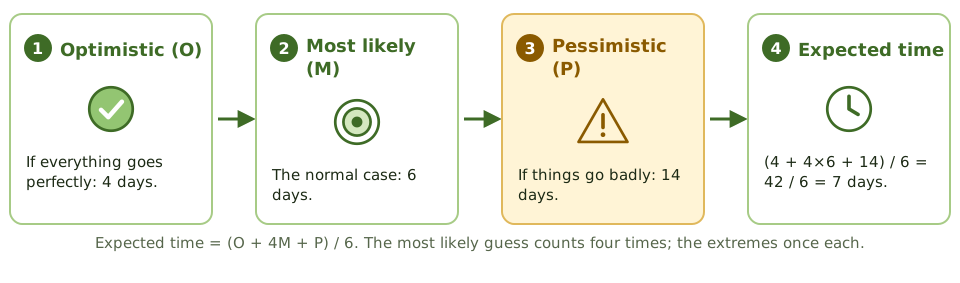
The most likely guess counts four times; the best and worst cases count once each. That allows for the range without letting one extreme dominate.
The critical path
The critical path is the longest chain of dependent tasks through the project. Its length is the shortest time in which the whole project can be finished.
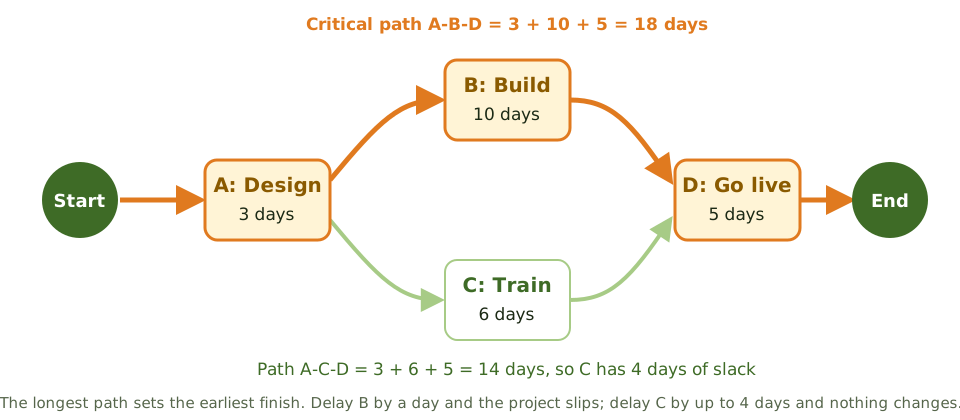
- Tasks on the critical path have zero slack: delay any of them by a day, and the project finishes a day late.
- Tasks off the critical path have slack (also called float): they can slip by that much without delaying the project.
- The critical path can change as tasks finish early or late, so it’s recalculated as the project goes.
In the example, the critical path is A-B-D (18 days). Task C has 4 days of slack. Putting more people on C won’t finish the project any sooner; speeding up B will.
Speeding things up
- Crashing: adding people or money to critical-path tasks to shorten them. It costs more.
- Fast-tracking: running tasks in parallel that were planned one after another. It adds risk.
Timebox management
Timeboxing fixes the delivery date and budget, and adjusts scope to fit, delivering the most important features first. It’s used in agile and RAD. It prevents schedule overruns, but needs disciplined prioritisation.
How the exam asks about it
| If the question asks… | The answer is usually… |
|---|---|
| What the critical path represents | The longest path, setting the minimum project duration |
| Slack on critical-path tasks | Zero |
| Technique using three time estimates | PERT |
| Weakness of a Gantt chart | It doesn’t clearly show dependencies or the critical path |
| Technique that fixes time and varies scope | Timebox management |
In short
- A Gantt chart shows tasks as bars on a timeline; good for tracking progress, weak at showing which tasks depend on each other.
- PERT uses three estimates per task (optimistic, most likely, pessimistic): expected time = (O + 4M + P) / 6.
- The critical path is the longest chain of dependent tasks; its length is the shortest possible project duration.
- Tasks on the critical path have zero slack: any delay delays the project.
- Tasks off the critical path have slack (float): they can slip a bit without delaying the project.
- Timeboxing fixes the deadline and adjusts scope to fit, as in agile and RAD.
Exam traps
- The critical path is the LONGEST path, not the shortest.
- Speeding up a task that isn't on the critical path doesn't finish the project sooner.
- PERT handles uncertainty with three estimates; CPM uses one estimate per task.
- A Gantt chart alone doesn't show which delays matter.
Slides
Click the slide and use the arrow keys. F toggles full screen.
PERT estimates
When you're unsure how long a task will take, PERT asks for three guesses and weights them.
The critical path