Topics in this domain
- Project Roles and Governance
- PMBOK Phases
- Gantt, PERT, Critical Path
- Function Point Analysis
- Earned Value and Project Risk
- Business Case and Feasibility
- Benefits Realization
- SDLC Phases Overview
- Requirements Definition
- System Design
- Waterfall vs. Iterative vs. Prototyping
- Agile
- DevOps and DevSecOps
- RAD, CASE, Low-Code
- Build, Coding Standards, Code Review
- Testing Levels: Unit, Integration, System, UAT
- Regression, Sociability, Parallel, Pilot Testing
- Defect Management
- Data Migration and Conversion
- Change-Over: Parallel, Phased, Abrupt
- Go-Live Readiness and Acceptance
- Post-Implementation Review
- Input Controls
- Processing Controls
- Output Controls
- Data Integrity and ACID
- EDI and E-Commerce Controls
Requirements Definition
Agreeing what to build
Ask a builder for “a nice kitchen” and you’ll get their idea of nice. Ask for “a 4-metre worktop, a double sink under the window, and space for a dishwasher” and you’ll get what you actually want. Requirements are that precise list, for a system.
Most failed projects trace back to requirements that were vague, incomplete, or never properly agreed.
Four kinds of requirement
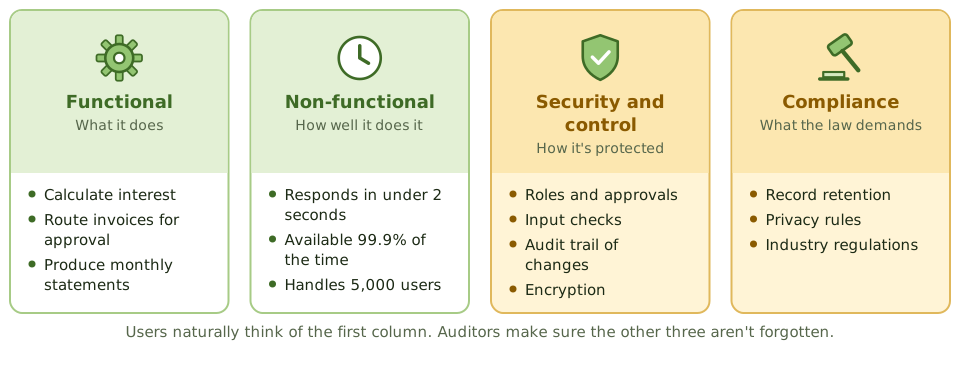
| Type | Describes | Examples |
|---|---|---|
| Functional | What the system must do | Calculate premiums; route invoices for approval; produce monthly statements |
| Non-functional | How well it must do it | Responds in under 2 seconds; 99.9% available; supports 5,000 users |
| Security and control | How data and processing are protected | Role-based access, segregation of duties, input validation, audit trails, encryption |
| Regulatory and compliance | Legal obligations | Data retention, privacy, accessibility, sector rules |
| Interface | How it talks to other systems | File formats, APIs, timing |
Users naturally focus on functionality, so security and control requirements are easily forgotten. The auditor checks they’re explicitly captured, because adding them later is expensive.
Vague vs testable
“The system should be secure” can’t be tested, so nobody can ever say it’s been met. Rewritten:
“Users log in with MFA. Sessions time out after 15 minutes of inactivity. Every change to customer bank details is logged with the user ID, time, and the old and new values.”
Now each part can be tested.
Good requirements are clear (one meaning), complete (including controls), consistent (no contradictions), testable, traceable (linked to a business need and to tests) and prioritised (must-have vs nice-to-have).
Gathering and approving
Requirements come from users and business owners, through interviews, workshops, observation, document reviews and prototypes. IT analysts write them up. Then they’re:
- checked with users for completeness and accuracy
- approved (signed off) by user management
- baselined, so later changes go through formal change control
Tracing requirements to tests
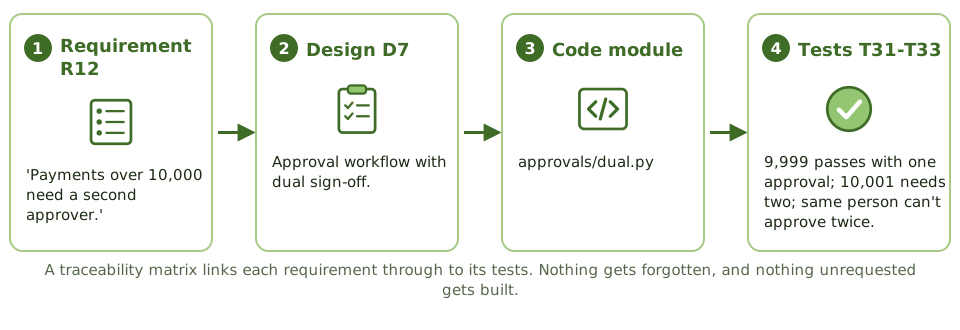
A requirements traceability matrix links every requirement to its design, code and test cases. It shows:
- every requirement was built and tested
- nothing was built that nobody asked for (“gold plating”)
- what a proposed change would affect
Why requirements go wrong
- the right users weren’t involved
- vague statements that can’t be tested
- missing non-functional and control requirements
- uncontrolled changes (scope creep)
- sign-off without a real review
How the exam asks about it
| If the question asks… | The answer is usually… |
|---|---|
| The most common cause of project failure | Poorly defined or changing requirements |
| Who approves requirements? | User / business management |
| The tool linking requirements to test cases | Requirements traceability matrix |
| The requirements are missing security controls | Add them now; it’s cheapest at this stage |
| What makes a requirement verifiable | It’s specific and testable |
In short
- Requirements describe what the system must do (functional) and how well (non-functional: speed, security, availability, usability).
- Security, control, audit trail and regulatory requirements must be included explicitly.
- Users and business owners define and approve requirements; IT helps document and analyse them.
- Good requirements are clear, complete, consistent, testable and traceable.
- A requirements traceability matrix links each requirement to design, code and test cases.
- Changes to approved requirements go through change control.
Exam traps
- Unclear or incomplete requirements are the most common cause of project failure and overruns.
- A requirement that can't be tested can't be verified.
- Users approve requirements, not developers.
- Leaving security requirements until design or build is too late.
Slides
Click the slide and use the arrow keys. F toggles full screen.
Four kinds of requirement
Tracing requirements to tests