Topics in this domain
- Project Roles and Governance
- PMBOK Phases
- Gantt, PERT, Critical Path
- Function Point Analysis
- Earned Value and Project Risk
- Business Case and Feasibility
- Benefits Realization
- SDLC Phases Overview
- Requirements Definition
- System Design
- Waterfall vs. Iterative vs. Prototyping
- Agile
- DevOps and DevSecOps
- RAD, CASE, Low-Code
- Build, Coding Standards, Code Review
- Testing Levels: Unit, Integration, System, UAT
- Regression, Sociability, Parallel, Pilot Testing
- Defect Management
- Data Migration and Conversion
- Change-Over: Parallel, Phased, Abrupt
- Go-Live Readiness and Acceptance
- Post-Implementation Review
- Input Controls
- Processing Controls
- Output Controls
- Data Integrity and ACID
- EDI and E-Commerce Controls
Regression, Sociability, Parallel, Pilot Testing
Four tests, four questions
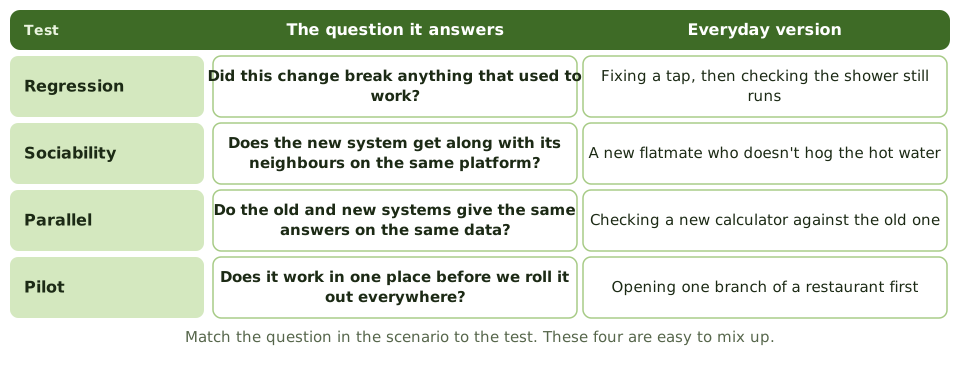
These four tests have confusing names, but each one answers a single, simple question. In the exam, find the question hidden in the scenario, and the right test follows.
Regression testing: did we break anything?
A plumber fixes your kitchen tap. Before leaving, a good one turns on the shower and flushes the toilet, because changing one pipe can affect the others. That’s regression testing.
Regression testing reruns earlier test cases after a change, to confirm that existing functionality still works. It uses the same test data and expected results as before, so any difference points straight to a problem the change introduced.
It’s needed after every change: enhancements, bug fixes, patches, configuration changes, and emergency fixes too. Automated regression suites make this practical when releases are frequent.
Sociability testing: does it get along with the neighbours?
Sociability testing confirms that a new or changed system can run in its target environment without harming the other systems there. It might compete for memory or disk, clash with a shared library, or corrupt shared data.
It’s about coexistence on the same platform and network, not just the data passed between systems (that’s interface or integration testing).
Example. A patch to the tax calculation module passes its own tests. Regression testing reruns the payroll suite and finds pension deductions now round differently. Separately, sociability testing on the shared server finds the patched module’s new logging fills up a disk that another application depends on.
Parallel testing: same input, same answer?
The old and new systems process the same data at the same time, and the results are compared. Differences are investigated before the old system is switched off.
- Strength: high confidence the new system gives correct results, and the old one is a ready fallback.
- Weakness: expensive; users do the work twice; the two systems must be comparable.
Pilot testing: try it in one place first
The system goes live in one location, department or group first. Problems are found and fixed while the impact is small, before wider roll-out.
Parallel and pilot are also changeover methods (see the implementation section). The exam uses the words in both senses.
Related tests
- Interface testing: does data pass correctly between systems?
- Recovery testing: can the system be recovered after a failure?
- Security testing: are access controls working, and are there vulnerabilities?
How the exam asks about it
| If the scenario says… | The test is… |
|---|---|
| Make sure the change didn’t affect existing functions | Regression |
| Make sure the new system doesn’t harm other systems on the same platform | Sociability |
| Compare results of old and new systems processing the same data | Parallel |
| Implement at one branch first, then roll out | Pilot |
| The data used in regression testing | The same data as in previous tests |
In short
- Regression testing checks that a change hasn't broken existing functionality; it reruns earlier tests after changes.
- Sociability testing checks that a new or changed system works in its target environment without adversely affecting other systems.
- Parallel testing runs the old and new systems with the same data and compares results.
- Pilot testing implements the system in one location or for one group first, before full roll-out.
- Regression test data should be the same as used in earlier tests, so results are comparable.
- Interface, recovery and security testing complement these.
Exam traps
- 'Works with other systems in the environment' = sociability, not integration.
- 'Changes didn't introduce new errors' = regression.
- 'Compare old and new system outputs' = parallel.
- 'One branch or department first' = pilot.
- Regression testing is needed after every change, including emergency fixes and patches.
Slides
Click the slide and use the arrow keys. F toggles full screen.
Four tests, four questions
These four tests sound alike, but each answers a different question. In the exam, find the question hidden in the scenario and the answer follows.