Topics in this domain
- IT Service Management
- Hardware Components and Architecture
- Operating Systems
- OSI Model
- TCP/IP and Common Protocols
- Network Devices: Switches, Routers, Gateways
- LAN/WAN Topologies
- Database Models and DBMS
- Database Controls and Normalization
- Asset Management
- Configuration Management
- Job Scheduling and Batch Processing
- Incident Management
- Problem Management
- Change Management
- Release and Patch Management
- Service Level Management
- Capacity and Performance Monitoring
- End-User Computing
- BCP Lifecycle
- Business Impact Analysis
- RTO, RPO, MTD, SDO
- Recovery Strategies
- Alternate Sites: Hot, Warm, Cold
- Backup Types: Full, Incremental, Differential
- Backup Storage and Rotation
- DRP Contents
- Testing BCP/DRP
- High Availability, RAID, Insurance
- Auditing BCP
Alternate Sites: Hot, Warm, Cold
Somewhere to go
If your home became unliveable, you could move into a furnished holiday flat and be settled the same day (hot). Or a flat with furniture but no bedding or food (warm). Or an empty flat where you bring everything yourself (cold). The faster option costs more.
Recovery sites work exactly like that.
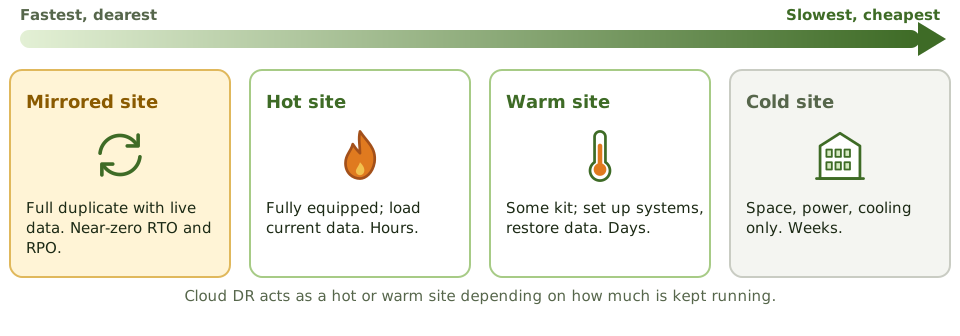
| Site | What’s there | Typical RTO | Cost |
|---|---|---|---|
| Mirrored (duplicate) | A full duplicate of the primary site with real-time data replication; may share the live load | Near zero | Highest |
| Hot | Fully configured hardware, software, network and environment; needs current data (restored or replicated) | Hours | High |
| Warm | Facilities, network connections and some equipment; systems must be set up and data restored | Days | Moderate |
| Cold | The basics only: space, power, cooling, cabling. Equipment must be bought and installed | Weeks | Low |
| Mobile | A transportable unit, such as a trailer, delivered to where it’s needed | Days | Moderate |
| Reciprocal agreement | Two organisations agree to host each other’s processing in a disaster | Uncertain | Low |
Cloud DR is now a common alternative. It behaves like a hot or warm site depending on how much is kept running.
Hot sites, usually commercial, are meant for short-term use, typically weeks, until the primary site or a longer-term alternative is ready. Contracts usually limit how long you can stay.
The trouble with reciprocal agreements
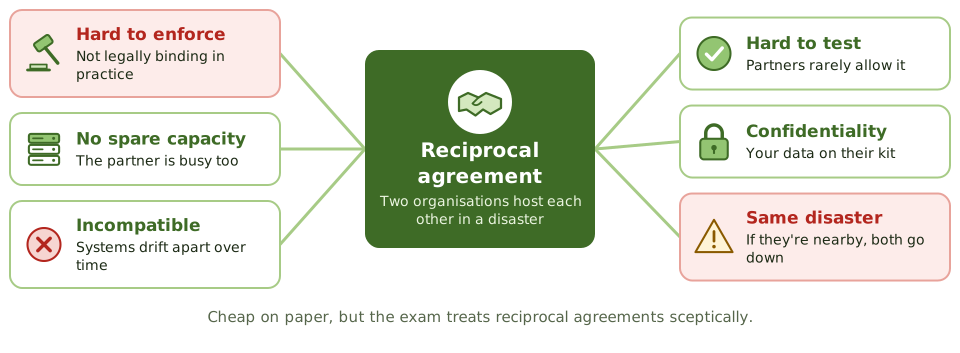
They’re cheap, but the exam treats them sceptically:
- hard to enforce legally
- the partner may have no spare capacity when you need it
- hardware and software may not be compatible, and drift further apart over time
- testing is difficult
- confidentiality concerns
- if the two organisations are close together, the same disaster can hit both
Read the contract first
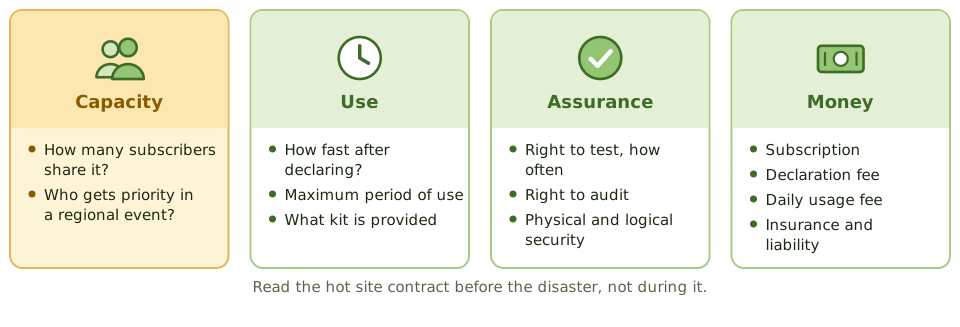
For a commercial recovery site, check:
- the hardware, software and network configuration to be provided
- how a disaster is declared, and how quickly the site is available
- the number of subscribers and the priority rules in a regional disaster (oversubscription risk)
- the maximum period of use
- testing rights and frequency
- physical and logical security at the site
- the right to audit
- insurance and liability
- costs: subscription, declaration fees, daily usage fees
Example. A company relies on a commercial hot site. The auditor reads the contract and finds the provider has 40 subscribers in the same city sharing one recovery floor, allocated first come, first served. In a regional event, the company might get nothing. The auditor recommends reviewing the subscriber ratio and priority terms, or a different strategy.
How the exam asks about it
| If the question asks… | The answer is usually… |
|---|---|
| Site that can be operational within hours | Hot site |
| Site with only space and utilities | Cold site |
| Main concern with a commercial shared site | Oversubscription in a regional disaster |
| Main weakness of reciprocal agreements | Not enforceable; capacity and compatibility issues |
| Site with near-zero RTO and RPO | Mirrored / duplicate site |
| Hot site intended for | Short-term use |
In short
- A hot site is fully equipped and can be operational within hours; it's the most expensive conventional option.
- A warm site has infrastructure and some equipment, but needs systems configured and data restored; recovery in days.
- A cold site provides space, power, cooling and connectivity only; equipment must be delivered; recovery in weeks.
- A mirrored (duplicate) site runs in parallel with real-time data, for near-zero RTO and RPO.
- Mobile sites are transportable units; reciprocal agreements share capacity with another organisation.
- Commercial site contracts should cover configuration, availability during regional disasters (oversubscription), testing rights, duration of use and audit rights.
Exam traps
- Hot sites are usually meant for short-term use (weeks), not indefinite operation.
- Commercial sites shared by many subscribers may be oversubscribed in a regional disaster.
- Cold sites are cheap but can't meet short RTOs.
- Reciprocal agreements are rarely enforceable and often break down on capacity and compatibility.
- The right to test at the site should be in the contract.
Slides
Click the slide and use the arrow keys. F toggles full screen.
Somewhere to go
If your home became unliveable, you could move into a furnished holiday flat and be settled the same day (hot). Or a flat with furniture but no food or bedding (warm). Or an empty flat where you bring everything yourself (cold). Faster costs more.
Recovery sites work the same way.
The trouble with reciprocal agreements
Read the contract first