Topics in this domain
- IT Service Management
- Hardware Components and Architecture
- Operating Systems
- OSI Model
- TCP/IP and Common Protocols
- Network Devices: Switches, Routers, Gateways
- LAN/WAN Topologies
- Database Models and DBMS
- Database Controls and Normalization
- Asset Management
- Configuration Management
- Job Scheduling and Batch Processing
- Incident Management
- Problem Management
- Change Management
- Release and Patch Management
- Service Level Management
- Capacity and Performance Monitoring
- End-User Computing
- BCP Lifecycle
- Business Impact Analysis
- RTO, RPO, MTD, SDO
- Recovery Strategies
- Alternate Sites: Hot, Warm, Cold
- Backup Types: Full, Incremental, Differential
- Backup Storage and Rotation
- DRP Contents
- Testing BCP/DRP
- High Availability, RAID, Insurance
- Auditing BCP
High Availability, RAID, Insurance
A spare tyre for everything
A car with a spare tyre keeps going after a puncture. A plane with two engines keeps flying if one fails. Neither helps if you drive off a cliff.
Fault tolerance lets a system keep running when a part fails. High availability (HA) designs whole services to minimise downtime, using spare parts and fast failover. Backups and insurance cover the cliff.
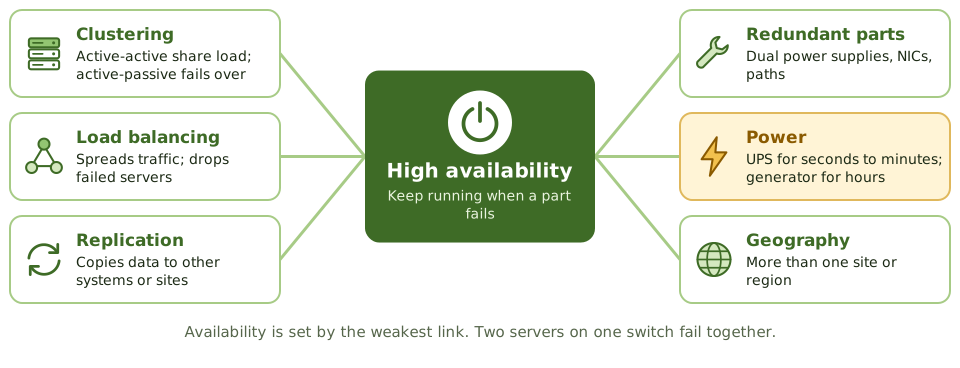
| Technique | How it works |
|---|---|
| Clustering | Several servers act as one. Active-active: all of them serve traffic. Active-passive: a standby takes over on failure. |
| Load balancing | Spreads traffic across servers and stops sending it to failed ones |
| Replication | Copies data to other systems or sites, synchronously or asynchronously |
| Redundant components | Dual power supplies, network cards, controllers, network paths |
| Redundant power | A UPS (batteries) bridges short interruptions and hands over smoothly; a generator covers long outages |
| Geographic redundancy | Services run in more than one site or cloud region |
The weakest link sets availability. Two redundant servers plugged into one switch, or one power feed, still fail together.
RAID
RAID (redundant array of independent disks) combines several disks for speed, protection or both.
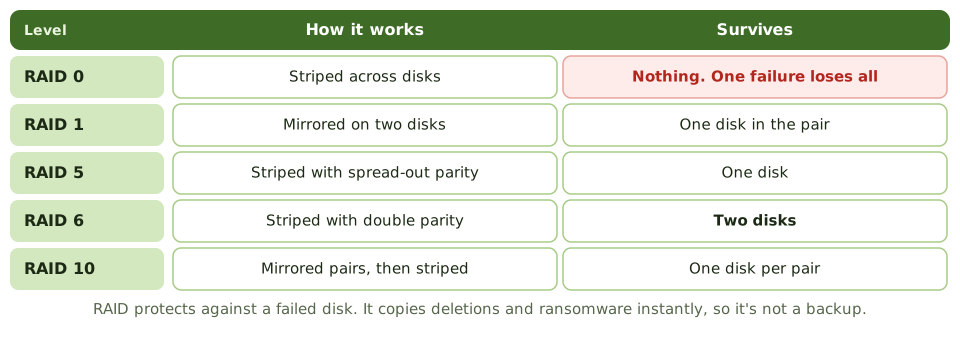
| Level | How | Survives |
|---|---|---|
| RAID 0 | Data striped across disks | Nothing. One failure loses everything, despite the name |
| RAID 1 | Data mirrored on two disks | One disk in the pair |
| RAID 5 | Striping with parity spread across all disks | One disk |
| RAID 6 | Striping with two sets of parity | Two disks |
| RAID 10 (1+0) | Mirrored pairs, then striped | One disk per mirrored pair |
RAID protects against a failed disk, and nothing else. It copies deletions, corruption and ransomware encryption instantly, and it’s no help if the whole array or site is lost. RAID is not a backup.
Example. A company relies on RAID 5 storage with nightly snapshots on the same array. Ransomware encrypts the volumes and deletes the snapshots. RAID faithfully protected the encrypted data. Only offline backups would have allowed recovery.
Insurance
Insurance moves some of the financial pain of a disaster to someone else.
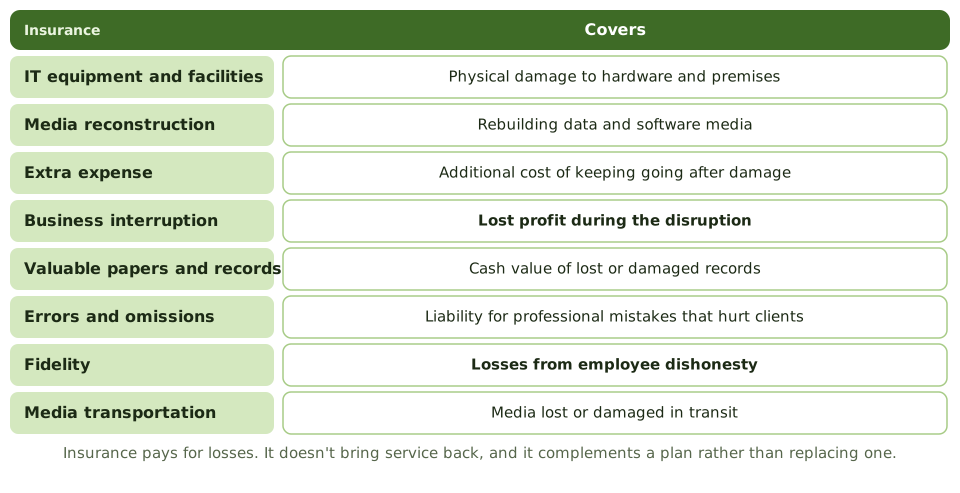
| Type | Covers |
|---|---|
| IT equipment and facilities | Physical damage to hardware and premises |
| Media (software) reconstruction | Rebuilding data and software media |
| Extra expense | Additional cost of keeping going after damage |
| Business interruption | Lost profit caused by the disruption (not replacement equipment) |
| Valuable papers and records | Cash value of records lost or damaged |
| Errors and omissions | Legal liability for professional mistakes that cause client losses |
| Fidelity coverage | Losses from employee dishonesty or fraud |
| Media transportation | Media lost or damaged in transit |
Cyber insurance policies often add incident response costs, breach notification, extortion and liability.
What insurance can’t do
Insurance doesn’t bring service back, can’t repair a damaged reputation, and may not cover regulatory fines. It complements a continuity plan; it never replaces one. The auditor checks that cover matches the risks identified, and that the policy’s conditions (such as required controls) are actually being met.
How the exam asks about it
| If the question asks… | The answer is usually… |
|---|---|
| RAID level with no redundancy | RAID 0 |
| RAID level using mirroring | RAID 1 |
| RAID level surviving two disk failures | RAID 6 |
| Does RAID replace backups? | No; it doesn’t protect against deletion, corruption or site loss |
| Insurance covering lost profit during an outage | Business interruption |
| Insurance covering employee theft | Fidelity coverage |
| Device bridging short power outages | UPS |
In short
- High availability reduces downtime through redundancy: clustering, load balancing, replication and redundant components.
- Active-active clusters share the load; active-passive clusters fail over to a standby.
- RAID 0 stripes with no redundancy; RAID 1 mirrors; RAID 5 stripes with distributed parity and survives one disk failure; RAID 6 survives two; RAID 10 combines mirroring and striping.
- RAID protects against disk failure, not against deletion, corruption, malware or site loss, so it doesn't replace backups.
- Power resilience uses UPS for short outages and generators for longer ones, with tested failover.
- Insurance transfers financial loss: IT equipment, media reconstruction, extra expense, business interruption, valuable records, errors and omissions, fidelity and media transportation.
- Insurance doesn't restore operations; it complements, not replaces, continuity planning.
Exam traps
- RAID 0 offers no fault tolerance, despite being RAID.
- RAID and replication aren't backups: deleting a file deletes it on every mirror.
- A single point of failure anywhere in the chain (power, network switch) defeats redundant servers.
- Business interruption insurance covers lost profit, not the cost of replacing equipment.
- Fidelity coverage protects against losses from employee dishonesty.
Slides
Click the slide and use the arrow keys. F toggles full screen.
A spare tyre for everything
A car with a spare tyre keeps going after a puncture. A plane with two engines keeps flying if one fails. Neither helps if you drive off a cliff.
High availability builds spares into IT so a single failed part doesn't stop the service. Backups and insurance cover the cliff.
RAID levels
Insurance