Topics in this domain
- IT Service Management
- Hardware Components and Architecture
- Operating Systems
- OSI Model
- TCP/IP and Common Protocols
- Network Devices: Switches, Routers, Gateways
- LAN/WAN Topologies
- Database Models and DBMS
- Database Controls and Normalization
- Asset Management
- Configuration Management
- Job Scheduling and Batch Processing
- Incident Management
- Problem Management
- Change Management
- Release and Patch Management
- Service Level Management
- Capacity and Performance Monitoring
- End-User Computing
- BCP Lifecycle
- Business Impact Analysis
- RTO, RPO, MTD, SDO
- Recovery Strategies
- Alternate Sites: Hot, Warm, Cold
- Backup Types: Full, Incremental, Differential
- Backup Storage and Rotation
- DRP Contents
- Testing BCP/DRP
- High Availability, RAID, Insurance
- Auditing BCP
Recovery Strategies
From targets to a plan
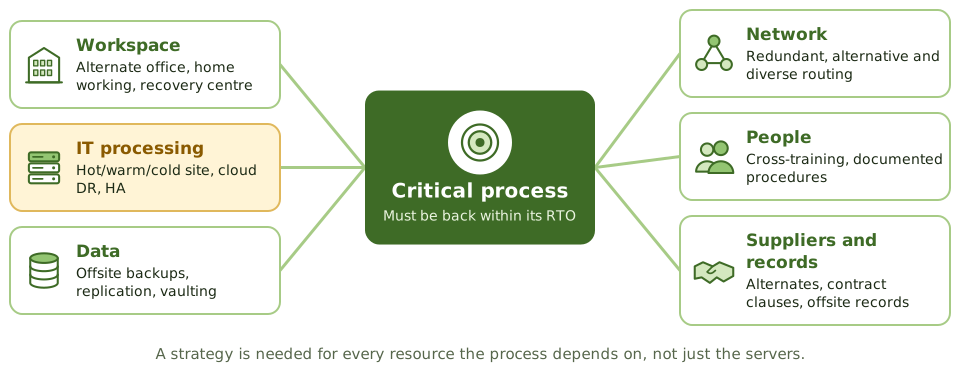
The BIA says the order process must be back within four hours. Fine, but back where? Running on what? With whose data? Operated by whom?
A recovery strategy answers those questions for every resource the process depends on, chosen to meet its RTO and RPO at a cost the downtime justifies. Strategies come after the BIA, are approved by senior management, put in place through contracts and infrastructure, written into the plan, and tested.
| Resource | Strategy options |
|---|---|
| Workspace | Alternate offices, working from home, commercial work-area recovery centres |
| IT processing | Hot, warm, cold, mobile or mirrored sites; cloud DR; high availability clusters; reciprocal agreements; vendor quick-ship |
| Data | Offsite backups, replication (synchronous or asynchronous), journaling, electronic vaulting |
| Networks | Redundant equipment and links; alternative and diverse routing; multiple carriers |
| People | Cross-training, documented procedures, succession plans, key staff not all in one place |
| Suppliers | Alternative suppliers, continuity clauses in contracts, reviews of suppliers’ own BCPs |
| Vital records | Offsite copies, digital archives |
Recovering the IT without people, desks or suppliers doesn’t recover the business.
IT options compared
| Option | RTO achievable | Cost | Notes |
|---|---|---|---|
| Active-active / mirrored site | Near zero | Very high | Both sites run live load |
| Hot site | Hours | High | Fully equipped; needs current data restored or replicated |
| Cloud DR | Minutes to hours | Variable; you pay for standby | Needs tested automation and guaranteed capacity |
| Warm site | Days | Medium | Partly equipped |
| Cold site | Weeks | Low | Space and utilities only |
| Reciprocal agreement | Uncertain | Low | Hard to enforce; capacity and compatibility problems |
Site types get their own article. Cloud DR still needs tested runbooks, working identity and network access, and capacity guaranteed in the contract.
Network recovery
Telecoms are often the weak link.
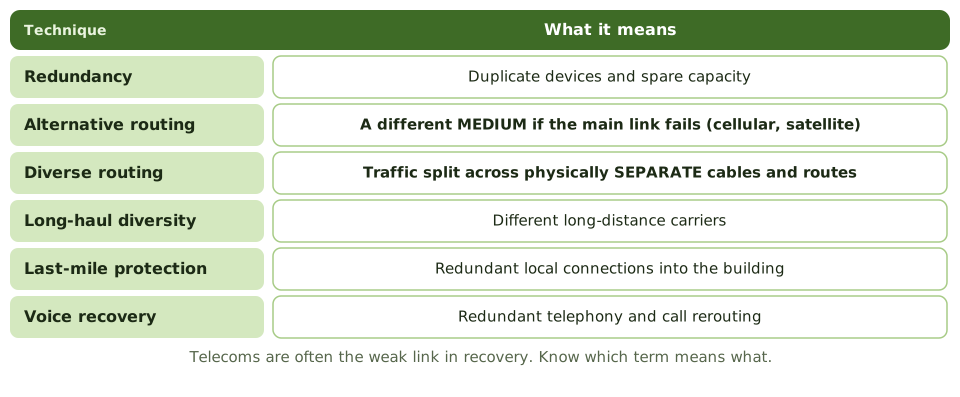
- Redundancy: duplicate devices and spare capacity
- Alternative routing: switch to a different medium (cellular, satellite) if the main link fails
- Diverse routing: split traffic across physically separate cables and routes
- Long-haul network diversity: use different long-distance carriers
- Last-mile circuit protection: redundant local connections into the building
- Voice recovery: redundant telephony and call rerouting
Don’t share the disaster
A recovery site should be far enough away not to be hit by the same event (the same flood plain, power grid or regional disaster), but close enough for staff to reach if needed. Many organisations choose a different region, or a different cloud region.
Example. A bank’s DR site is 15 km from its primary data centre, on the same river. A regional flood closes both. The strategy met the RTO on paper but didn’t consider shared regional risk.
How the exam asks about it
| If the question asks… | The answer is usually… |
|---|---|
| Basis for selecting recovery strategies | RTO and RPO from the BIA, balanced against cost |
| Recovery technique using a different medium if a link fails | Alternative routing |
| Technique splitting traffic across separate physical cables | Diverse routing |
| Main weakness of reciprocal agreements | Enforceability, capacity and compatibility |
| Recovery site location concern | Must not be exposed to the same regional risks |
In short
- A recovery strategy is the approach for restoring business processes and IT within their recovery objectives at acceptable cost.
- Strategies are selected from the BIA's RTO and RPO and the cost trade-off between downtime and recovery.
- Strategies are needed for every resource a process depends on: facilities, IT systems, data, networks, people, suppliers and records.
- IT options include alternate sites, cloud-based DR, high availability, replication, reciprocal agreements and vendor quick-ship arrangements.
- Network recovery uses redundancy, alternative routing, diverse routing and last-mile protection.
- Strategies must be approved by senior management and reflected in the plan and tested.
Exam traps
- The strategy is chosen after the BIA, not before.
- Recovering IT without people, workspace or suppliers doesn't recover the business.
- A recovery site in the same area as the primary site can be hit by the same disaster.
- Cloud DR still needs tested runbooks, identity and network access, and contractual capacity.
- Reciprocal agreements are cheap but hard to enforce and often fail on compatibility or capacity.
Slides
Click the slide and use the arrow keys. F toggles full screen.
From targets to a plan
The BIA says the order process must be back within four hours. Fine, but back where, on what, with whose data, run by whom?
A recovery strategy is the answer for every resource the process depends on, chosen to meet its RTO and RPO at a cost the downtime justifies. Senior management approves it; the plan documents it; tests prove it.
Network recovery