Topics in this domain
- IT Service Management
- Hardware Components and Architecture
- Operating Systems
- OSI Model
- TCP/IP and Common Protocols
- Network Devices: Switches, Routers, Gateways
- LAN/WAN Topologies
- Database Models and DBMS
- Database Controls and Normalization
- Asset Management
- Configuration Management
- Job Scheduling and Batch Processing
- Incident Management
- Problem Management
- Change Management
- Release and Patch Management
- Service Level Management
- Capacity and Performance Monitoring
- End-User Computing
- BCP Lifecycle
- Business Impact Analysis
- RTO, RPO, MTD, SDO
- Recovery Strategies
- Alternate Sites: Hot, Warm, Cold
- Backup Types: Full, Incremental, Differential
- Backup Storage and Rotation
- DRP Contents
- Testing BCP/DRP
- High Availability, RAID, Insurance
- Auditing BCP
OSI Model
Sending a parcel
Sending a parcel abroad happens in layers. You write the letter (application). You translate it and seal it in an envelope (presentation). You agree to keep writing back and forth (session). You number the boxes so none go missing (transport). You address them to a city and street (network). The local van picks them up from your door (data link). And the van drives on the road (physical).
The OSI (Open Systems Interconnection) model splits network communication into those same seven layers. For the exam, it’s a shared vocabulary for where things happen: which device handles which traffic, and at which layer a control works.
The seven layers
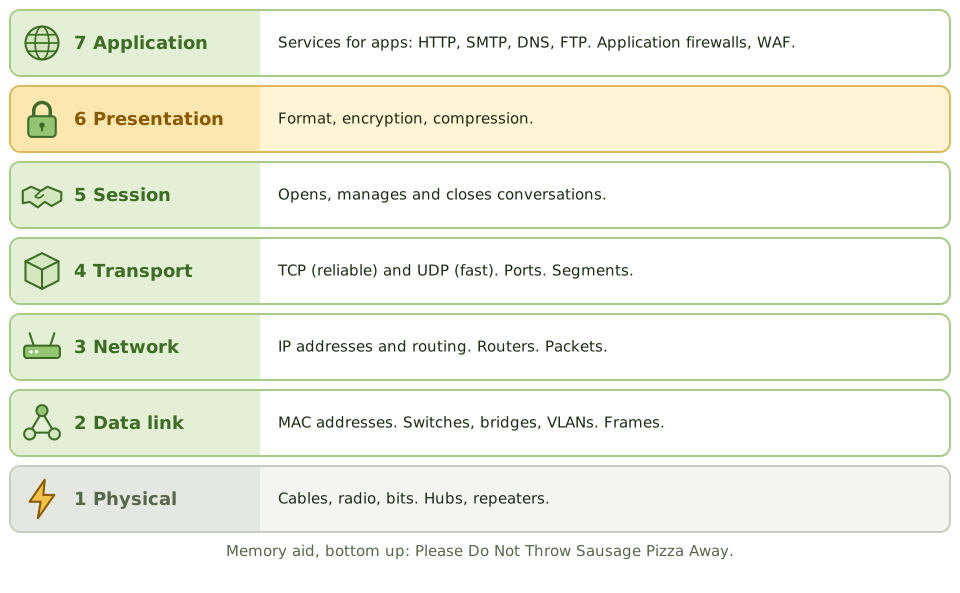
| # | Layer | What it does | Data unit | Examples |
|---|---|---|---|---|
| 7 | Application | Network services for applications | Data | HTTP, SMTP, FTP, DNS, SNMP |
| 6 | Presentation | Format, encryption, compression | Data | Character encoding, image formats, encryption |
| 5 | Session | Opens, manages and closes conversations | Data | RPC, NetBIOS, checkpoints |
| 4 | Transport | End-to-end delivery, error recovery, ports | Segment | TCP (reliable), UDP (fast, no guarantees) |
| 3 | Network | Logical (IP) addressing and routing | Packet | IP, ICMP, routers |
| 2 | Data link | Physical (MAC) addressing, framing | Frame | Ethernet, Wi-Fi, switches, bridges |
| 1 | Physical | Bits over a cable or radio | Bits | Cables, fibre, radio, hubs, repeaters |
Memory aid, from layer 1 up: Please Do Not Throw Sausage Pizza Away.
Devices by layer
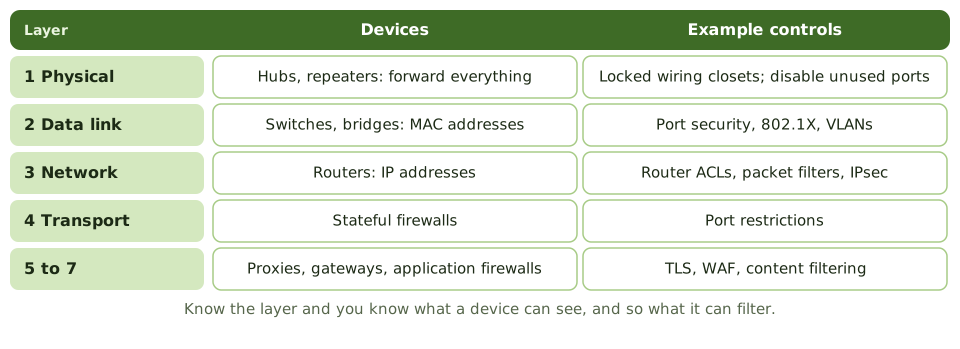
A device can only filter what it can see:
- Layer 1: hubs and repeaters just regenerate the signal and send it everywhere. They can’t filter anything.
- Layer 2: switches and bridges forward frames by MAC address. VLANs are set up here.
- Layer 3: routers forward packets between networks by IP address. A layer 3 switch does both.
- Layers 4 to 7: firewalls, proxies, load balancers and gateways. A gateway translates between different protocols or architectures and can work all the way up to layer 7.
Controls by layer
| Layer | Example controls |
|---|---|
| Physical | Cable protection, locked wiring closets, disabling unused ports |
| Data link | Port security, MAC filtering, 802.1X, VLAN segregation |
| Network | Router access control lists, packet-filtering firewalls, IPsec |
| Transport | Stateful firewalls, port restrictions |
| Presentation / application | TLS, application-layer firewalls, proxies, web application firewalls (WAF) |
A packet-filtering firewall works at layers 3 and 4. An application firewall works at layer 7 and can see the actual request.
Example. A question asks which device would separate traffic between two departments based on IP address. A switch (layer 2) can create VLANs, but routing between them by IP address happens at layer 3. So the answer is a router, or a layer 3 switch with access control lists.
How the exam asks about it
| If the question asks… | The answer is usually… |
|---|---|
| Layer where routers operate | Network (3) |
| Layer where switches operate | Data link (2) |
| Layer handling encryption and data formatting | Presentation (6) |
| Layer of TCP and UDP | Transport (4) |
| Device translating between different protocols | Gateway |
In short
- The OSI model has seven layers: physical, data link, network, transport, session, presentation, application.
- Layer 1 physical: cables, signals, hubs, repeaters. Layer 2 data link: frames, MAC addresses, switches, bridges.
- Layer 3 network: IP addressing and routing, routers. Layer 4 transport: TCP and UDP, ports, reliability.
- Layer 5 session manages dialogues; layer 6 presentation handles formatting, encryption and compression; layer 7 application is where user-facing protocols run.
- Gateways can operate up to layer 7 and translate between different protocols.
- Knowing the layer tells you which device or control acts on the traffic.
Exam traps
- Switches work at layer 2 (MAC addresses); routers at layer 3 (IP addresses).
- Hubs and repeaters are layer 1 and forward everything; they can't filter.
- Encryption and data format conversion belong to the presentation layer in the OSI model.
- A packet-filtering firewall works at layers 3 and 4; an application firewall at layer 7.
Slides
Click the slide and use the arrow keys. F toggles full screen.
The seven layers
Devices and controls by layer