Topics in this domain
- IT Service Management
- Hardware Components and Architecture
- Operating Systems
- OSI Model
- TCP/IP and Common Protocols
- Network Devices: Switches, Routers, Gateways
- LAN/WAN Topologies
- Database Models and DBMS
- Database Controls and Normalization
- Asset Management
- Configuration Management
- Job Scheduling and Batch Processing
- Incident Management
- Problem Management
- Change Management
- Release and Patch Management
- Service Level Management
- Capacity and Performance Monitoring
- End-User Computing
- BCP Lifecycle
- Business Impact Analysis
- RTO, RPO, MTD, SDO
- Recovery Strategies
- Alternate Sites: Hot, Warm, Cold
- Backup Types: Full, Incremental, Differential
- Backup Storage and Rotation
- DRP Contents
- Testing BCP/DRP
- High Availability, RAID, Insurance
- Auditing BCP
LAN/WAN Topologies
Networks come in sizes
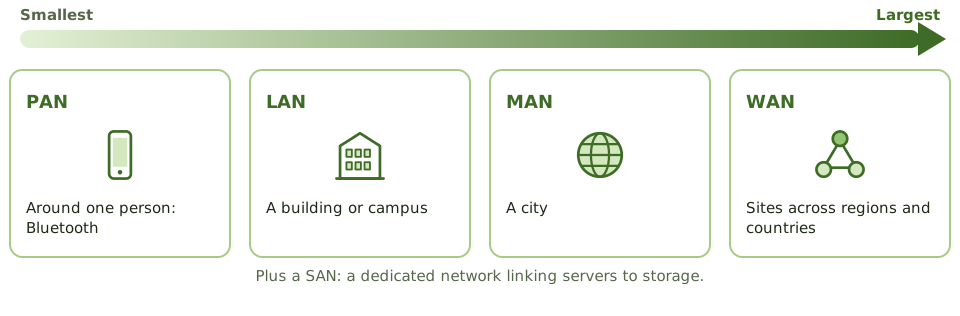
| Type | Covers |
|---|---|
| PAN | Devices around one person (Bluetooth) |
| LAN | A building or campus |
| MAN | A city |
| WAN | Long distances, connecting sites and regions |
| SAN | A dedicated network linking servers to storage |
Networks come in shapes
Think of roads. One long street everyone lives on: close it, and nobody gets anywhere (bus). A roundabout with driveways off it: one closed driveway affects one house, but close the roundabout and everything stops (star). A ring road (ring). Or a city grid with many routes between any two points: the most resilient, and the most expensive to build (mesh).
The topology is the shape of the network. For the exam, ask one question of each: what single failure takes everything down?
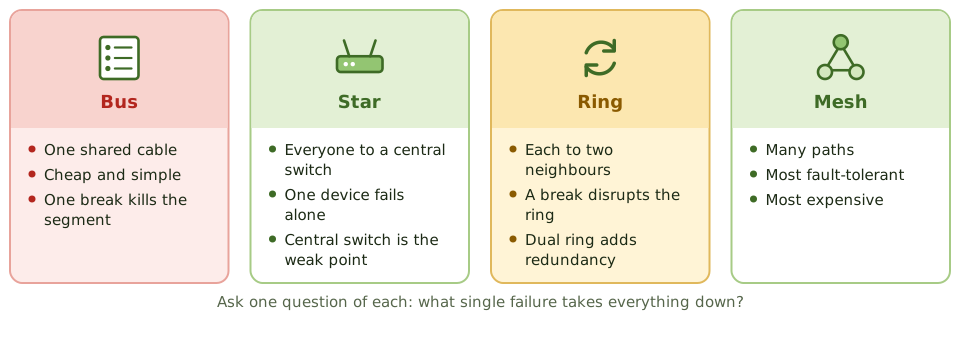
| Topology | Description | Advantages | Disadvantages |
|---|---|---|---|
| Bus | All devices share one cable | Simple, cheap | One cable break or fault takes down the whole segment; hard to troubleshoot |
| Star | Each device connects to a central switch | Easy to manage; one device failing doesn’t affect others | The central switch is a single point of failure |
| Ring | Each device connects to two neighbours in a loop | Predictable performance | A break disrupts the ring; a dual ring adds redundancy |
| Mesh | Devices linked by multiple paths (full or partial) | Most fault-tolerant | Most expensive and complex |
Most modern LANs are switched stars, often with duplicated core switches. WAN cores often use a partial mesh.
Cables and wireless
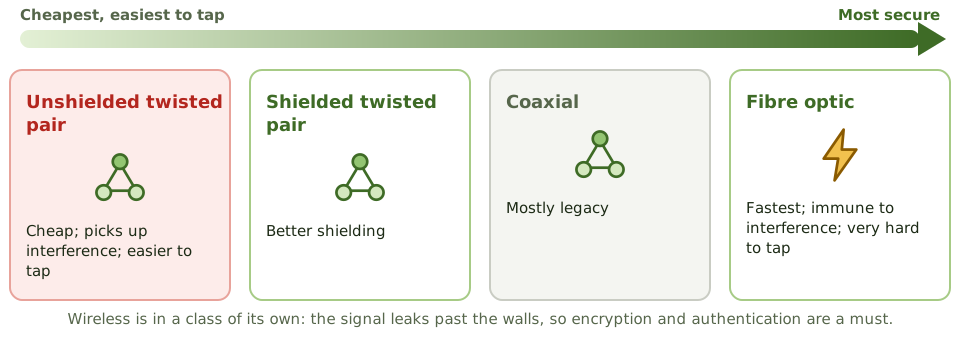
- Twisted pair (unshielded or shielded): cheap and common, but picks up electromagnetic interference and is easier to tap.
- Coaxial: better shielding; now mostly legacy.
- Fibre optic: fastest and longest-reaching, immune to electromagnetic interference, and very hard to tap. The most secure wired option.
- Wireless: convenient, but the signal leaks beyond the walls, so strong encryption and authentication are a must.
Cabling should be physically protected: in conduits and locked closets, and away from sources of interference.
Connecting sites (WAN)
- Leased lines: dedicated point-to-point circuits; predictable but costly.
- MPLS: a carrier-managed private network that can prioritise traffic.
- Internet VPNs: encrypted tunnels over the public internet.
- SD-WAN: software that manages several links (MPLS, broadband, 4G/5G) as one.
- Older terms still turn up in questions: circuit switching, packet switching, frame relay, ISDN.
Real redundancy
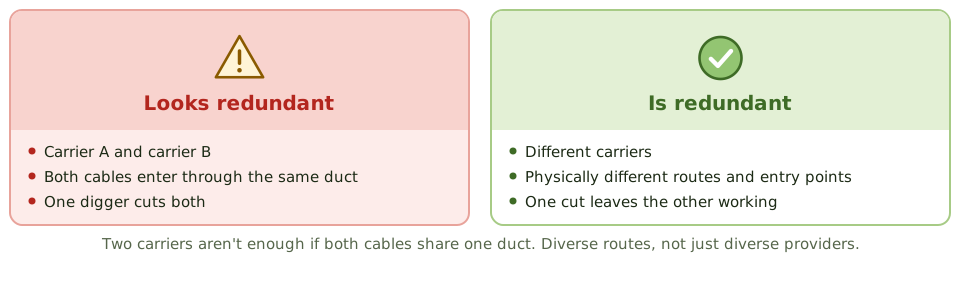
Critical sites should have links from different carriers along physically different routes, so one cable cut can’t take out both.
Example. A company has two WAN links to its data centre, from two different carriers. Both enter the building through the same duct, which is cut during roadworks. Diverse routing, not just diverse carriers, was the missing control.
How the exam asks about it
| If the question asks… | The answer is usually… |
|---|---|
| Most fault-tolerant topology | Mesh |
| Single point of failure in a star | The central switch or hub |
| Most secure cable against tapping | Fibre optic |
| Medium most susceptible to interference | Unshielded twisted pair |
| Key consideration for redundant WAN links | Different carriers and physically diverse routes |
In short
- Network types by scope: PAN, LAN, MAN, WAN; plus SAN for storage.
- Star topology: all nodes connect to a central device; a single node failure is isolated but the central device is a single point of failure.
- Bus topology: one shared cable; a break can take down the whole segment.
- Ring topology: each node connects to two others; a break disrupts the ring unless it's a dual ring.
- Mesh topology: multiple paths between nodes; most resilient and most expensive.
- Fibre optic cable is most secure and resistant to interference; unshielded twisted pair is cheapest and most susceptible.
- WAN options include MPLS, leased lines, SD-WAN and VPNs over the internet.
Exam traps
- Mesh gives the most redundancy; star depends on its hub or switch.
- Fibre is hardest to tap and immune to electromagnetic interference.
- Wireless signals extend beyond physical boundaries, so they need encryption and authentication.
- Redundant WAN links should use different carriers and physical routes, or they may fail together.
Slides
Click the slide and use the arrow keys. F toggles full screen.
Networks come in sizes
Networks come in shapes
Think of roads. One long street everyone lives on (bus): close it and nobody gets anywhere. A roundabout with spokes (star): one closed driveway affects one house, but close the roundabout and everything stops. A ring road. Or a city grid with many routes (mesh): the most resilient, and the most expensive to build.
Cables and wireless
Real redundancy