Topics in this domain
- IT Service Management
- Hardware Components and Architecture
- Operating Systems
- OSI Model
- TCP/IP and Common Protocols
- Network Devices: Switches, Routers, Gateways
- LAN/WAN Topologies
- Database Models and DBMS
- Database Controls and Normalization
- Asset Management
- Configuration Management
- Job Scheduling and Batch Processing
- Incident Management
- Problem Management
- Change Management
- Release and Patch Management
- Service Level Management
- Capacity and Performance Monitoring
- End-User Computing
- BCP Lifecycle
- Business Impact Analysis
- RTO, RPO, MTD, SDO
- Recovery Strategies
- Alternate Sites: Hot, Warm, Cold
- Backup Types: Full, Incremental, Differential
- Backup Storage and Rotation
- DRP Contents
- Testing BCP/DRP
- High Availability, RAID, Insurance
- Auditing BCP
Configuration Management
A map of the plumbing
Before a plumber turns off a valve, they want to know which taps it feeds. Turn off the wrong one, and the whole building loses water.
Configuration management keeps that map for IT. It records each component that makes up a service (a configuration item, or CI), its settings, and how the components depend on each other. And it makes sure changes to them are controlled.
The four activities
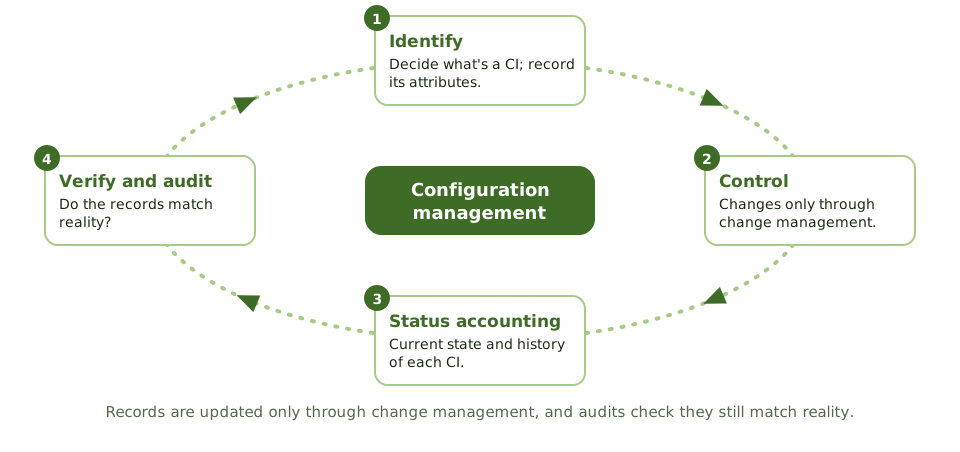
- Identification: decide what counts as a CI and record its attributes (version, owner, location, settings).
- Control: CIs change only through change management.
- Status accounting: track each CI’s current state and history.
- Verification and audit: check the records match reality.
Configuration management records and controls the configuration; change management approves changes to it. They work as a pair.
The CMDB
The configuration management database (CMDB) stores CI records and, more importantly, the relationships between them.
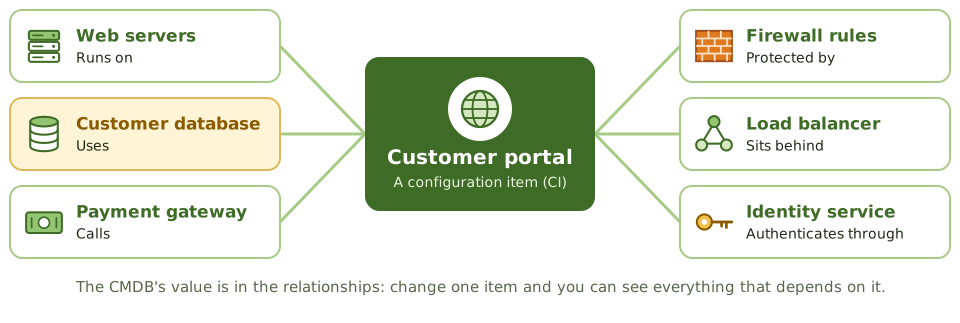
That’s what makes it useful for:
- change impact analysis: what else will this change affect?
- incident diagnosis: which components are involved?
- problem management: what do these repeat incidents have in common?
- recovery planning: what must be rebuilt, and in what order?
- security: which systems run the vulnerable version?
Baselines
A baseline is an approved configuration at a point in time: a known good state.
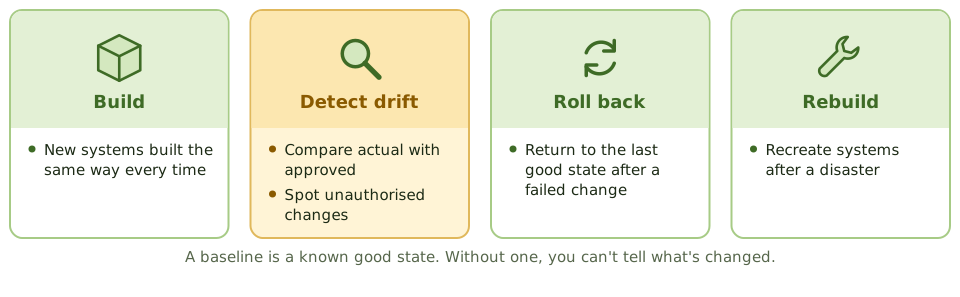
Baselines are used to build new systems consistently, detect unauthorised changes (configuration drift) by comparison, roll back after a failed change, and rebuild after a disaster. Without a baseline, you can’t tell what’s changed.
A wrong map is worse than none
An inaccurate CMDB leads people to make confident decisions on wrong information. To keep it accurate:
- updating the CMDB is part of closing every change, not optional paperwork
- automated discovery and configuration monitoring compare the real state with the recorded state
- periodic configuration audits
Example. A change to a shared database server is approved as low risk because the CMDB shows only one application uses it. In fact, four other applications were moved there last year without CMDB updates. The change takes all five down. The root cause: a CMDB not maintained through change management.
How the exam asks about it
| If the question asks… | The answer is usually… |
|---|---|
| Database of CIs and their relationships | CMDB |
| Purpose of a configuration baseline | Reference point for changes, detecting drift and recovery |
| How CMDB records should be updated | Through change management |
| Best way to verify CMDB accuracy | Compare it with actual configurations (automated discovery or audit) |
In short
- Configuration management identifies configuration items (CIs), records their attributes and relationships, and controls changes to them.
- The configuration management database (CMDB) holds CI records and how they depend on each other.
- A baseline is an approved configuration at a point in time, used as a reference for changes and recovery.
- Configuration management supports change impact assessment, incident diagnosis, and recovery.
- CI records are updated only through change management; regular audits (verification) confirm the CMDB matches reality.
- Configuration drift from baselines is detected by automated comparison.
Exam traps
- An inaccurate CMDB is worse than none: decisions get made on wrong data.
- Updating the CMDB is part of closing a change, not optional paperwork.
- Configuration management controls the configuration; change management approves changes to it. They work together.
- Baselines are needed to detect unauthorised changes.
Slides
Click the slide and use the arrow keys. F toggles full screen.
A map of the plumbing
Before a plumber turns off a valve, they want to know which taps it feeds. Turn off the wrong one, and the whole building loses water.
Configuration management keeps that map for IT: every component (a configuration item, or CI), its settings, and what depends on what.
The four activities
Baselines